Glass that knows its own shape
A pane of glass over a photograph should do two things: swell what is behind it, and bend it hard at the edge. Ours did the second along two axes, which is right for a rectangle and wrong for every rounded corner in the library.
Two ramps cannot round a corner
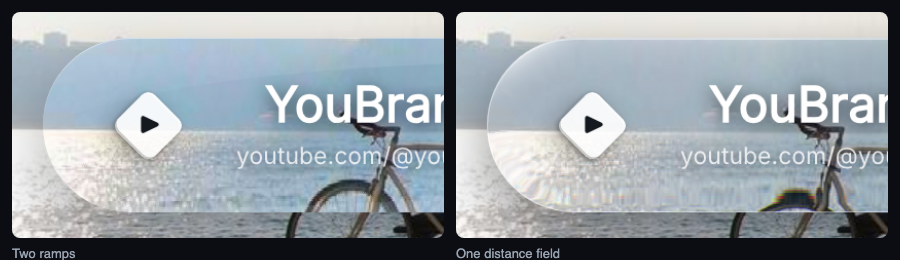
The refraction behind the glass templates was separable: one gradient ramp across the pane, one down, added together and handed to an SVG displacement filter. That is exactly right for a rectangle. It is wrong everywhere a rectangle is not.
A channel bar with an eighty-five pixel radius is a pill. A horizontal ramp can only bend sideways, because sideways is the only thing it knows — so at the rounded end the picture behind was sheared along the axis rather than wrapped around the shape. Put it over a shoreline and the horizon ran straight off the end of the glass instead of curving with it. The shape read as a rectangle somebody had clipped.
A signed distance field knows the shape. For every point on the pane it answers two questions — how far is the edge, and which way does it lie — so the bend follows the silhouette the whole way round: hard into a corner, gentle along a straight run, and the same strength in both. Measured at the same depth, a corner and a flat edge now bend within a tenth of each other. The ramps were out by half.
It hands over the surface normal for nothing, which is what a highlight is made of. The rim catches light where it actually faces the light, rather than under a painted gradient laid across the whole pane.
The middle was flat, and a lens is not
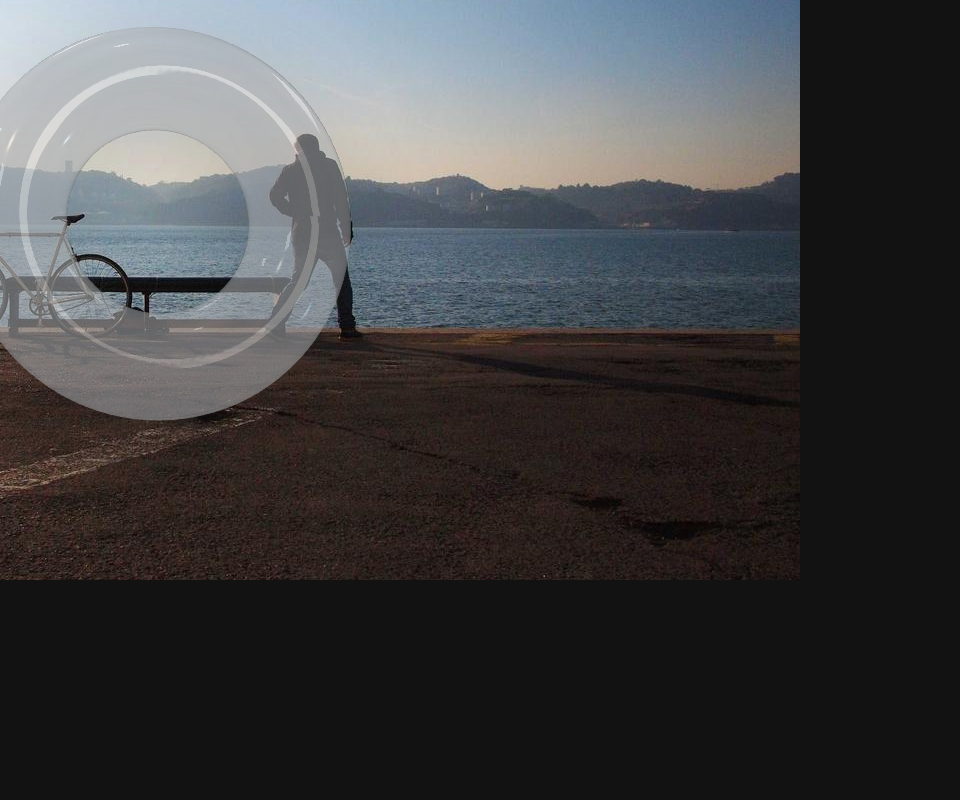
Bending at the rim is half of it. A convex surface turns a ray by its own slope, and a sphere's slope rises with the distance from its axis — so every point is pulled toward the middle in proportion to how far out it is. That proportional pull is a magnification, and it is why a photograph behind real glass swells.
The old model had none of it: the centre of the pane was left alone by design, and one of the first tests written for the new field asserted the same thing before the dome existed. A rim effect with a flat, dead centre is a frame, not a lens.
Both surfaces of one piece of glass, added. The dome magnifies across the whole pane; the lip is a hard extra turn in the last few per cent of the edge, where a band of the picture compresses into the rim and gives it thickness. On a long bar the dome is a cylinder rather than a dome — it magnifies across the width and not along the length, which is what a bar of glass with a rounded profile actually does.
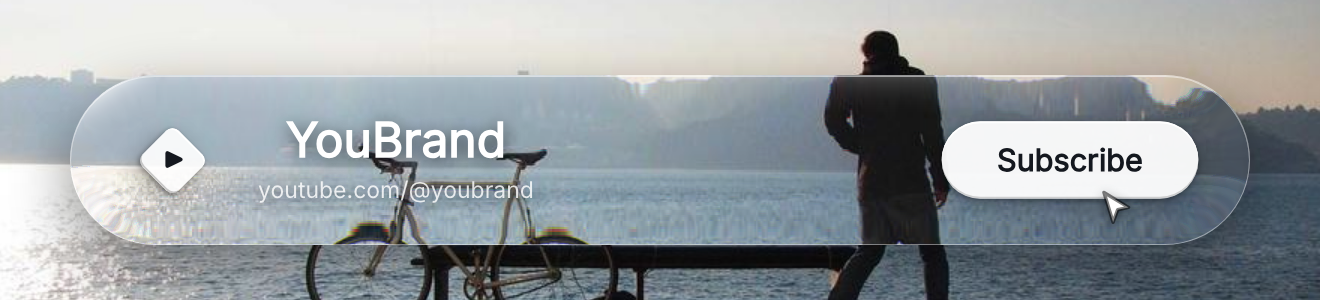
Clear, which meant taking things away
Every other glass in the editor frosts what is behind it and lifts its colour. That is how you make a pane read as glass when it cannot actually bend anything: blur it, saturate it, lay a white gradient across the top at a third opacity, and the eye fills in the rest.
This one bends, so it needs none of them — and each one was actively hiding the work. A blur over a magnification obscures the very detail that proves it is a lens. A saturation boost over a magnified photograph reads as a stain. The painted highlight is a guess at a rim light, and there is now a real one computed from the surface itself.
So the new material carries no blur, no saturation lift, a film thin enough to be a sheen on the surface rather than a tint through it, and dispersion at a fifth rather than a half. A magnified high-contrast edge fringes on its own; any more and the colour split reads as an artefact instead of a lens.
The panes already in the library keep the old model. Their look was chosen against it, and quietly restyling twenty-four templates because the machinery underneath improved is not an upgrade anybody asked for.
The same glass, as a solid
Optic glass is on the 3D shelf too, beside the four glasses that were already there. One property separates it: dispersion splits what passes through into its colours, which is the thread of red and blue along an edge that reads as real glass rather than as translucent plastic.
Thin walls and a high index of refraction. A thick, soft-edged solid hides what is behind it, and not hiding it is the whole point of this one.
One thing worth knowing before reaching for it: a transmissive 3D surface refracts its own studio environment, not the layers behind it in the composition. The solid looks like glass and has real depth, but it will not bend a photograph sitting behind it the way the flat pane does.
One field, both renderers
The screen rasterises the field into an image — red carrying the horizontal offset, green the vertical, blue the rim's own light — and hands it to an SVG filter. The exporter samples the same field per vertex of a finer mesh and screens the same highlight on.
That is deliberate, and this codebase has been bitten often enough to be careful about it: a pane that wraps its rounded end in the preview and shears it in the exported file is worse than one that shears in both. Same numbers, same picture.
Optic Glass Bar is in the library now, on the Channel Bar shelf beside Liquid Glass Bar and Cast Glass Bar, and every layer of it is editable like any other. Or pick Optic glass from the material list on a shape you already have.